
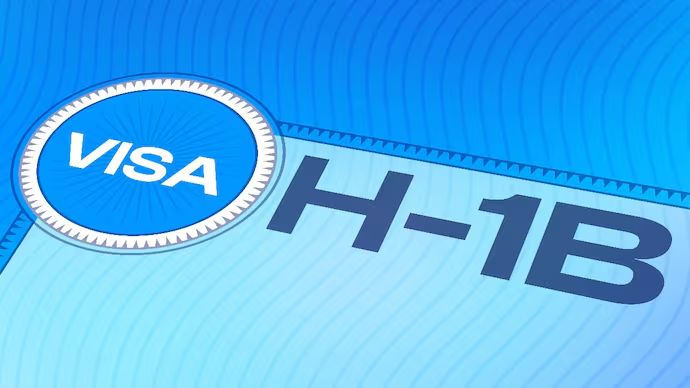
New H-1B Fee Proposal Clears White House Review: Will Indian Professionals Bear the Biggest Impact?
By Samaran | Founding Editor, Jananaayakan.com
August 21, 2026
WASHINGTON / NEW DELHI — A new U.S. government proposal concerning fees for H-1B petitions has cleared a crucial White House regulatory review, bringing another potentially significant change to America’s skilled-worker visa system closer to public release.
RelatedPosts




The development deserves particular attention in India. Indian professionals have historically been the dominant nationality among H-1B beneficiaries, especially across technology, engineering and other specialised occupations. Any substantial increase or restructuring of petition costs could therefore have consequences not only for American employers but also for thousands of Indian professionals seeking U.S. employment.
However, there is an important distinction: the new fee has not yet taken effect, and its full details have not yet been publicly released.
The Department of Homeland Security proposal was cleared by the White House’s Office of Information and Regulatory Affairs, or OIRA, on Wednesday, according to Bloomberg Law. The proposal carries the regulatory identifier RIN 1615-AD20.
That clearance represents an important procedural milestone, but it should not be interpreted as an immediate increase in H-1B fees.
What Exactly Has Happened?
The proposal deals with fees associated with petitions for workers under the H-1B programme, one of the principal routes through which American employers recruit highly skilled foreign professionals.
White House regulatory review is generally one of the important stages through which significant federal regulations pass before publication.
The proposal has now cleared that stage.
But as of August 21, the complete text has not been publicly released. Consequently, three crucial questions remain unanswered:
- How much will the proposed fee be?
- Which H-1B petitions or employers will be subject to it?
- When could the new fee structure become effective?
Until the proposal itself is published, claims giving definitive answers to these questions should be treated cautiously. Reports on the clearance similarly emphasise that the fee amounts and precise scope remain unclear.
Why India Is Watching Closely
The H-1B programme has enormous importance for India’s technology workforce and its economic relationship with the United States.
For decades, Indian engineers, software developers, technology specialists, consultants and other professionals have formed a substantial component of America’s H-1B workforce.
That means a policy technically imposed on employers filing petitions can ultimately influence Indian workers indirectly.
Higher sponsorship costs could encourage companies to become more selective about whom they sponsor. Large multinational corporations may be capable of absorbing additional immigration expenses, but startups, smaller technology companies and specialised employers could respond differently.
The consequences would therefore depend heavily on the final structure of the rule.
A modest administrative adjustment would produce a very different impact from a substantial new petition charge.
The Bigger H-1B Transformation
The fee proposal should not be viewed in isolation.
The Trump administration is pursuing a wider restructuring of the H-1B system.
DHS has separately listed a proposal titled “Reforming the H-1B Nonimmigrant Visa Classification Program.” According to the federal regulatory agenda, that proposal contemplates revising eligibility for certain cap exemptions, increasing scrutiny of employers that have violated programme requirements and strengthening oversight of third-party placements.
DHS says those measures are intended to improve programme integrity and protect American workers’ wages and working conditions.
That broader policy direction is significant.
The emerging H-1B debate is therefore no longer simply about who qualifies for a visa. It increasingly involves cost, employer compliance, selection mechanisms, job displacement concerns and the conditions under which foreign professionals can remain in the United States.
The $100,000 Question
The latest proposal also comes against the backdrop of the Trump administration’s controversial $100,000 H-1B payment requirement, announced in September 2025 for certain new H-1B petitions involving workers outside the United States.
USCIS guidance described that payment as a one-time requirement applying to covered new H-1B petitions rather than an annual fee.
That distinction is particularly important because the newly reviewed proposal should not automatically be confused with the existing $100,000 requirement.
The latest DHS proposal concerns another potential modification to H-1B petition fees. Until its text is released, it would be premature to conclude that every H-1B applicant, existing visa holder or Indian professional will face a particular new amount.
Could Indian IT Companies Face Higher Costs?
Potentially, yes — but the scale remains uncertain.
India’s major technology companies have spent years reducing their dependence on traditional H-1B-heavy staffing models by increasing local recruitment in the United States, expanding offshore delivery and restructuring their global workforces.
Nevertheless, immigration policy remains an important operating factor for the Indian IT industry.
The market demonstrated that sensitivity on August 21, when Indian technology stocks came under pressure amid renewed concerns over H-1B policy and other sector-specific factors.
If the final proposal materially increases petition expenses, companies could respond through greater localisation of U.S. hiring, increased offshore work from India, more selective visa sponsorship or alternative global delivery arrangements.
For highly specialised workers, employers may continue to absorb additional costs because their expertise is difficult to replace.
For more easily substitutable roles, however, higher immigration costs could change the economics of sponsorship.
Does This Mean Existing Indian H-1B Holders Should Panic?
No.
The White House review does not mean that every Indian H-1B holder suddenly owes a new fee.
Nor does it mean that an approved H-1B visa has automatically become invalid.
At this stage, the most important development is regulatory rather than operational: the proposal has cleared White House review and is moving toward public release.
Once the proposal is formally published, its language will reveal who is covered, what payments are proposed, whether exemptions exist and how the government intends to implement the changes.
That is when a more precise assessment of its impact on Indian workers and employers will become possible.
Why Washington Is Tightening the Programme
The H-1B programme sits at the centre of a long-running American political argument.
Supporters contend that it allows U.S. companies to recruit specialised talent that strengthens innovation, competitiveness and economic growth.
Critics argue that employers can misuse the system to obtain lower-cost foreign labour or weaken employment opportunities for American workers.
The Trump administration’s current regulatory direction clearly places greater emphasis on enforcement, employer accountability and protection of the domestic workforce.
For India, however, H-1B is much more than an immigration issue.
It is connected to the world’s most important technology relationship.
Indian professionals have helped build major sections of America’s software, cloud computing, semiconductor, engineering, healthcare technology and artificial-intelligence ecosystems. At the same time, American companies maintain enormous technology and research operations in India.
An excessively expensive or unpredictable visa regime could therefore produce effects in both countries.
The Real Question: Who Ultimately Pays?
The most important economic question surrounding the forthcoming proposal may not simply be “How high is the fee?”
It is:
Who ultimately bears the cost?
If employers absorb it, corporate recruitment budgets rise.
If companies compensate by sponsoring fewer workers, foreign professionals face fewer opportunities.
If businesses shift more positions offshore, some employment and investment could move outside the United States.
And if the changes primarily discourage smaller businesses while major corporations continue sponsoring workers, the policy could unintentionally favour companies with deeper financial resources.
These possibilities cannot be measured accurately until DHS publishes the proposed rule.
Jananaayakan Analysis
For Indian professionals, the latest development should be treated seriously — but not sensationally.
The White House clearance confirms that another H-1B policy change is moving forward. It does not establish that every H-1B worker will face a new fee, nor does it reveal how much employers may ultimately have to pay.
The real impact will depend on the regulatory text.
But the direction of U.S. immigration policy is becoming increasingly clear: the H-1B system is entering an era of higher scrutiny, greater employer accountability and potentially higher costs.
For India, that transformation matters enormously.
A generation of Indian professionals has viewed the H-1B programme as one of the most important pathways into America’s technology economy. If Washington significantly increases the financial and regulatory burden associated with that pathway, Indian workers will inevitably feel some of the consequences — even when the legal bill is technically paid by their employers.
The next critical moment will therefore be the publication of the proposal itself.
Only then will India know whether this is primarily an administrative fee adjustment — or another major turning point in America’s increasingly restrictive H-1B landscape.