


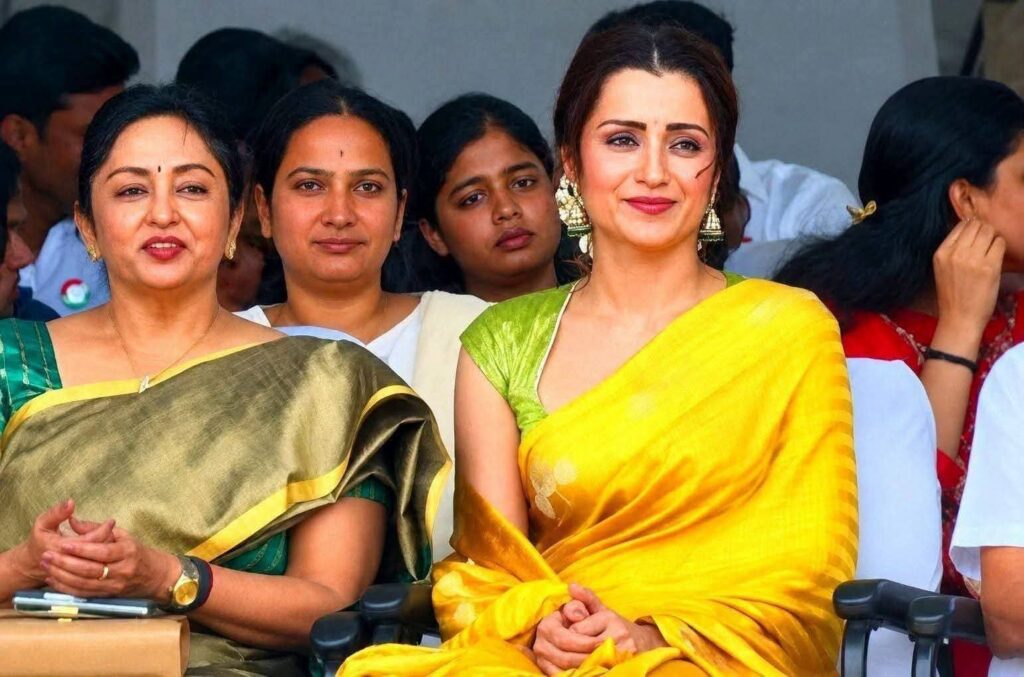
Is Trisha at the Centre of a Political Battle Targeting CM Vijay?
From personal remarks to Independence Day controversy, why is actor Trisha Krishnan repeatedly being pulled into Tamil Nadu’s political confrontation?
By Samaran | Founding Editor, Jananaayakan.com
August 18, 2026
CHENNAI — Actor Trisha Krishnan has spent more than two decades as one of Tamil cinema’s most recognisable stars. She does not hold elected office, has not announced a formal political role and is not known to occupy any position in the Tamil Nadu government.
Yet, remarkably, her name has repeatedly surfaced in one of Tamil Nadu’s fiercest contemporary political confrontations — the battle surrounding Chief Minister C. Joseph Vijay.
The latest flashpoint came after Trisha attended Tamil Nadu’s Independence Day celebrations at Fort St. George on August 15, where Vijay hoisted the national flag for the first time as Chief Minister. Trisha was seated in the front-row area alongside members of Vijay’s family, and videos showing an exchange of salutes and gestures between them rapidly circulated online.
What might ordinarily have remained a celebrity moment at a state ceremony has instead developed into a political controversy.
The DMK’s official mouthpiece, Murasoli, has now criticised Vijay over Trisha’s prominent presence at the Independence Day event, questioning the appropriateness of the seating arrangement and their interaction during the ceremony.
The controversy raises a larger question:
Has Trisha become a political proxy through whom Vijay’s opponents can attack the Chief Minister?
The available evidence does not establish an organised campaign centred on Trisha. But the frequency with which her name is being inserted into political attacks against Vijay makes the phenomenon increasingly difficult to dismiss as an isolated episode.
Independence Day Becomes the Latest Flashpoint
On August 15, Trisha attended the official Independence Day celebrations at Fort St. George in Chennai.
Footage showed her seated near Vijay’s parents and interacting with the Chief Minister during the event. Videos of Trisha returning a salute and later waving towards Vijay attracted enormous social-media attention.
Her presence itself was notable because this was not the first major political occasion at which she had been seen alongside Vijay’s family.
Trisha was also present around Vijay’s family during his swearing-in as Tamil Nadu Chief Minister in May. Her appearance at both events has subsequently generated considerable public and media speculation.
But speculation surrounding personal relationships is not evidence of political wrongdoing.
That distinction is crucial.
There is no publicly established evidence that Trisha holds governmental authority, participates in Cabinet decisions or exercises an official role in Vijay’s administration.
Therefore, legitimate questions about protocol at government functions should be separated from speculation concerning the private lives of individuals attending them.
DMK Escalates the Attack
The political significance of the Independence Day episode increased sharply when Murasoli targeted Vijay over Trisha’s presence.
Reports on the editorial say it questioned why the actor occupied such a prominent position and criticised the interaction between her and the Chief Minister during the official ceremony.
That criticism can be viewed from two different perspectives.
The opposition is entitled to question government protocol, access, appointments and the use of official platforms. A Chief Minister’s conduct at a state ceremony is legitimately subject to political and media scrutiny.
But when scrutiny moves from public administration to insinuations about personal relationships, the democratic value of that criticism becomes much harder to defend.
That is particularly true when a woman who does not hold political office becomes the vehicle for attacks primarily directed at a male political leader.
This Did Not Begin on Independence Day
The current controversy is part of a wider pattern.
Earlier this month, remarks involving Trisha during political exchanges between DMK leader Udhayanidhi Stalin and Vijay triggered a major controversy. Police subsequently registered a case, and Udhayanidhi was arrested over alleged derogatory remarks concerning the actor.
Trisha’s name has also surfaced in attacks from other political quarters.
Recent television coverage has explicitly examined the recurring tendency to bring Trisha into political arguments involving Vijay, including controversial remarks attributed to political leaders.
Even before these incidents, a birthday post involving Vijay in June had generated political and social-media controversy.
Taken individually, each episode can be treated as another political controversy.
Taken together, however, they reveal a pattern worthy of serious scrutiny.
Is Trisha Being Used as a Political Proxy?
Political attacks often seek a target that is emotionally powerful, personally sensitive and capable of dominating public conversation.
Trisha satisfies all three conditions.
She is enormously recognisable. Her professional association with Vijay stretches back years through Tamil cinema. Public curiosity surrounding the two guarantees that almost any reference involving them generates attention.
That makes her name politically potent.
An attack mentioning government expenditure, policy or administration may remain confined to political audiences.
An attack involving Vijay and Trisha can immediately cross into cinema, television, YouTube, social media and popular culture.
From the perspective of political communication, therefore, bringing Trisha into an attack on Vijay dramatically increases its potential reach.
But reach does not equal legitimacy.
If criticism concerns Vijay’s administration, the government should be challenged over its policies, appointments, expenditure, governance and performance.
If questions concern protocol at an official event, those questions can be asked directly.
Dragging a non-political woman into personal insinuations risks replacing democratic scrutiny with character politics.
The Gender Question Cannot Be Ignored
There is also a deeper problem.
Why should a woman repeatedly become collateral damage in political battles between male leaders?
The debate has now become sufficiently prominent that national television discussions have explicitly asked why women are being dragged into Tamil Nadu’s political confrontations.
This is not merely about Trisha.
Indian political discourse has repeatedly witnessed wives, daughters, mothers, female colleagues and women from the entertainment industry being invoked to attack male politicians.
Such rhetoric changes the subject from public accountability to personal humiliation.
That distinction matters in a democracy.
Trisha is a public figure and therefore cannot reasonably expect freedom from legitimate journalistic scrutiny. But being a celebrity does not automatically transform her personal life into a legitimate instrument of partisan political warfare.
Vijay’s Opponents Still Have Legitimate Questions to Ask
None of this means Vijay should be insulated from scrutiny.
Quite the opposite.
As Chief Minister, Vijay must face rigorous questioning over every significant aspect of his government.
Opposition parties have every democratic right to examine who receives access to the Chief Minister, whether government appointments are transparent, whether political allies or former cinema associates receive preferential treatment, and whether protocol is followed at state functions.
Indeed, reports surrounding the latest Murasoli criticism indicate that questions have also been raised about appointments involving individuals associated with Vijay’s film career.
Those are legitimate subjects for investigative journalism if supported by documentary evidence.
But such questions should be examined through records, appointment orders, eligibility criteria and government procedures — not through rumours about private relationships.
A Dangerous Political Distraction
There is another consequence to the Trisha-centred controversy.
Every day Tamil Nadu politics spends discussing a celebrity’s seating position, gesture or alleged personal relationship is a day when attention is diverted from governance.
The state faces substantial questions involving employment, investment, infrastructure, education, public health, law and order, welfare expenditure and the delivery of Vijay’s electoral promises.
Those issues directly affect millions of citizens.
Celebrity-driven political controversy may generate clicks and television debates, but it rarely helps voters assess whether their government is succeeding.
That is why political parties — government and opposition alike — have a responsibility to maintain the distinction between accountability and sensationalism.
Jananaayakan Analysis: Trisha Is Becoming a Political Symbol
The evidence currently available does not justify claiming that there is a coordinated political conspiracy specifically targeting Trisha.
Such a conclusion would require considerably stronger evidence.
What can reasonably be said is that a recognisable pattern has emerged: Trisha’s name and her perceived proximity to Vijay are repeatedly being used within political narratives aimed at the Chief Minister.
The Independence Day controversy has pushed that pattern into sharper focus.
Trisha has consequently become something she never publicly announced an intention to become — a political symbol.
For Vijay’s opponents, references to her provide a way to question his judgment, image and personal conduct.
For Vijay’s supporters, attacks involving Trisha provide evidence of what they regard as an increasingly personal and misogynistic opposition campaign.
For the media, meanwhile, the challenge is to avoid turning political scrutiny into celebrity gossip.
The Real Test for Tamil Nadu Politics
Tamil Nadu has one of India’s most politically engaged electorates.
It also possesses a political culture historically intertwined with cinema.
Vijay’s transition from superstar to Chief Minister has inevitably intensified that relationship.
But the state’s political discourse now faces an important test.
Can Vijay be challenged without attacking people in his personal orbit?
Can the opposition investigate his administration without reducing the debate to insinuation?
And can political parties disagree fiercely without dragging women who hold no political office into their confrontation?
Those questions extend far beyond Trisha.
A healthy democracy requires an aggressive opposition, an accountable government and an independent media.
But it also requires boundaries.
Chief Minister Vijay should be questioned relentlessly on governance wherever evidence warrants it.
Trisha Krishnan should be questioned where her own public actions legitimately warrant scrutiny.
What democracy should resist is using one person merely as a weapon to politically wound another.
At present, Trisha appears increasingly caught in a battle that is fundamentally not about her.
The real political contest is over Vijay. Trisha, however, is increasingly being placed at its centre.